


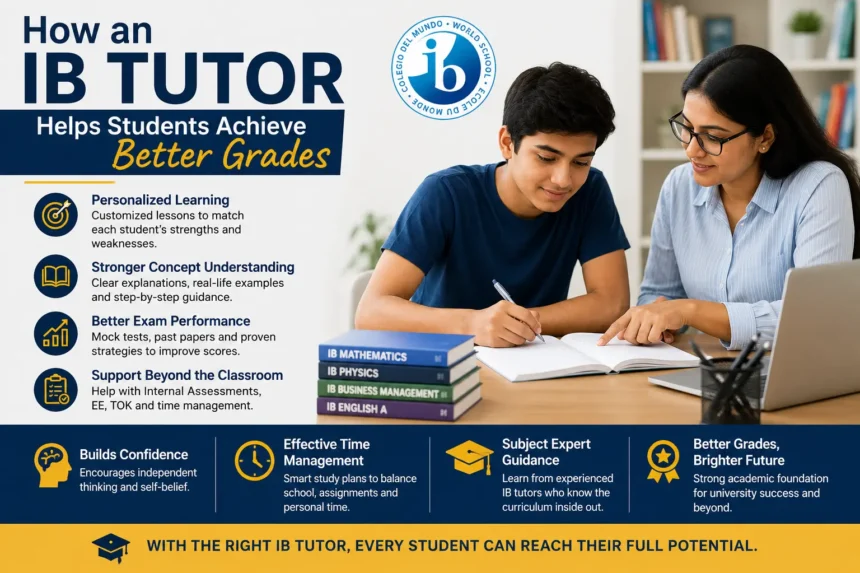
The International Baccalaureate Diploma Programme is considered one of the most challenging pre-university programs in the world. The challenging balance of six subject areas, the essay on Theory of Knowledge, the Extended Essays and the CAS (Creativity, Activities, Service) requirements is an intellectual challenge, the equivalent of which can be found in few education systems. It is in this context that the value of a committed IB tutor has become more than just beneficial — it’s a game-changer.
IB tutoring is not a mainstream academic tutoring. A good IB teacher will know the philosophy of the IB Programme, its internal and external assessments and the subtle nuances of the marking criteria that examiners apply. Its expertise is directly transferred to the students who invest in targeted tutoring support.
Understanding the IB’s Unique Demands
It is important first to understand the challenges facing students before discussing the support provided by tutors. Students are required to study subjects in all six groups: language and literature, language acquisition, individuals and societies, sciences, mathematics and the arts, in addition to completing extended independent research and philosophical inquiry through TOK. This breadth is by design, as the IB seeks to produce graduates who are well-rounded and internationally-minded.
There’s a price for breadth. Many students have strengths in some areas that are compromised by weaker performance in others. A student who is a gifted scientist may find the analytical writing requirements of History HL too difficult; a humanities student may find Mathematics Analysis and Approaches too difficult. An IB tutor understands these pressure points and can offer mastery of the subject area as well as insight into the IB assessment process.
A great IB tutor isn’t just retelling the syllabus – they’re reading the examiner’s mind, revealing exactly how the examiner will be earning and losing marks.
Personalised Learning: The Core Advantage
The most important thing the IB tutor can do to boost the grades is to personalise. A teacher has to pace a lesson to the majority in a 25-student classroom. The student who understands differentiation will quickly fall to the “waiting” level, and the student needing three worked examples to understand integration quietly falls behind. An IB tutor takes this compromise out of the equation.
The tutor can, in one-to-one or small group, locate the specific points of confusion—conceptual, procedural or academic language/expression—and correct them on-the-spot. Sessions evolve dynamically. A student who suddenly understands a concept in the middle of the class is not “left behind”, and a student who is having difficulty is not embarrassed but is given another explanation, some extra practice, and room.
Mastering Internal Assessments
Internal Assessments carry a substantial weighting of the final IB grade (between 20% and 30% of the final IB grade, depending on the subject). It is also the place that students tend to leave marks on the table most often. If a student does not have a clear understanding of the IB’s published criteria for assessment, he might submit a great piece of scientific research, but fail to receive a high score because the work was not written in the language and format that the examiner is expecting.
The IB experienced tutor is familiar with these criteria. They help students choose appropriate IA topics, organise their investigations, present their results appropriately, and develop evaluations which clearly address higher band descriptors. This coaching, which is based on the criteria alone, can transform an IA from 16 to 22, which is a significant improvement that then impacts the final grade.
There are no products in this category.
The IB examiners are renowned for their attention to detail in the use of command terms. Describe, explain, evaluate and discuss are not synonymous — they require very different responses and have different mark allocations. Many good students lose marks, not through lack of knowledge, but through failing to read the question correctly.
An expert IB tutor practices the recognition of command terms until they become second nature. They take students through past papers and compare mark schemes with model answers, showing them exactly what gets marks and what doesn’t. This is the most valuable thing a student can do before sitting their papers – decoding the examiner’s expectations.
The Extended Essay, an independent research project of 4,000 words, and the Theory of Knowledge essay are the most intellectually unique requirements of the IB. They are also the elements that most often overwhelm students, especially those not used to the conventions of academic argument and scholarly writing.
An IB tutor guides and critically reads through these processes. They assist them in selecting a research question for the Extended Essay from a very broad topic, in finding reliable and valid sources to support their writing, in creating a logical line of argument, and in following academic standards for referencing. In TOK, they can help students to break away from facile claims, and to deal with real epistemological complexity – the thinking that scores in the higher bands.
How to build confidence and minimise examination anxiety
Academic achievement is never a purely intellectual affair. One of the major factors that lead to underperformance in the IB – a programme that can make students feel that they are constantly behind – is anxiety, self-doubt and bad study habits. A knowledgeable IB tutor also covers this aspect. Working together, over weeks and months, this tutor/student relationship establishes a space where they can ask questions freely, make mistakes without consequences, and celebrate their progress.
Students who use trusted tutors go into their exams with a different mindset. They are aware that their weaker zones are taken care of. They have been practised with timed conditions. They know the examiner’s requirements. This mixture of preparedness and confidence is very potent in an examination setting.
CONCLUSION
The IB Diploma is an amazing qualification – really difficult, really intellectual and really well recognised by universities all over the world. However, it requires more than just intelligence and hard work. It needs to be planned strategically, be well known with the assessment criteria and be performed consistently in a variety of subjects and tasks.
This is precisely what an experienced IB tutor can offer: content expertise, programme-specific knowledge and understanding, and a personalised environment that meets each student’s needs. From a 5 to 7, to a struggling IA, to finally mastering the TOK essay, the right tutor can make the difference between a good and exceptional result. That difference is huge in a qualification where one grade could be the difference between receiving an offer from a university.