

Most energy audits in manufacturing plants focus on the obvious targets — motors, lighting, HVAC. Rarely does anyone look closely at the seals. And yet a surprising share of wasted energy in industrial facilities starts with exactly that: a seal that isn’t holding pressure the way it’s supposed to.
- Why Energy Loss Often Starts With Poor Sealing
- How Inflatable Seals Work
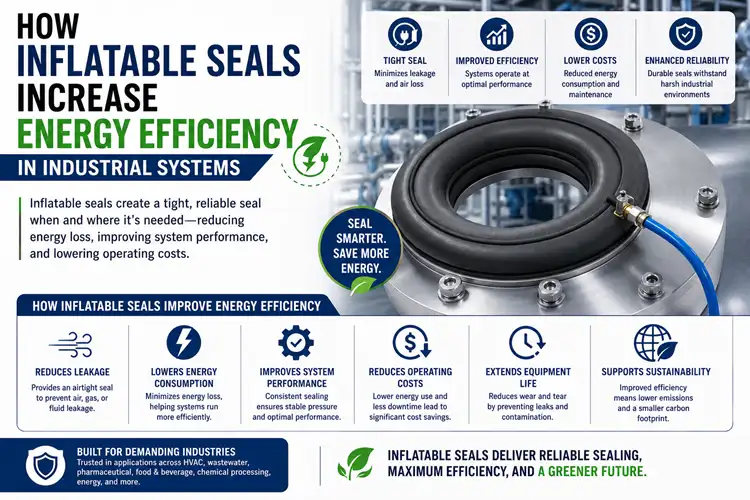
- How Inflatable Seals Improve Energy Efficiency
- The Hidden Cost of Compressed Air Leaks
- Inflatable Seals vs. Traditional Gaskets
- The Link Between Inflatable Seals and Sustainable Manufacturing
- Calculating ROI on Better Sealing
- Industries That Benefit Most
- Choosing the Right Inflatable Seal Material
- Common Mistakes That Reduce Energy Efficiency
- How to Maximize Inflatable Seal Performance
- Choosing the Right Inflatable Seal Manufacturer
- Frequently Asked Questions
- The Bottom Line
This isn’t a minor inefficiency, either. Air leaks, vacuum leaks, and pressure instability all force equipment to work harder to maintain the conditions it’s designed to run at — which means more energy spent, more wear on the equipment doing the compensating, and a slow, steady cost that rarely shows up as a single line item anyone notices.
Inflatable seals address this at the source. This guide covers exactly how they improve leak prevention and pressure control, what that means for a facility’s sustainability goals, and where the real energy savings actually come from.
Why Energy Loss Often Starts With Poor Sealing
A seal that isn’t performing correctly rarely fails all at once. It leaks a little air here, loses a bit of vacuum integrity there, lets pressure drift slightly out of range — and equipment compensates by working harder to hold the conditions it’s supposed to maintain.
Air leaks force compressors to run more to maintain system pressure. Vacuum leaks make vacuum pumps work overtime to hold the vacuum level a process actually needs. Heat loss through poor door or chamber sealing means more energy spent reheating or recooling. Pressure instability leads to inconsistent process results, which often means rework — itself a hidden energy cost. And all of this adds up to equipment inefficiency and, eventually, unplanned downtime once a marginal seal finally fails outright.
None of these problems look dramatic in isolation. Together, across a whole facility, they represent real, recoverable energy waste.
How Inflatable Seals Work
An inflatable seal is a hollow elastomer profile that does nothing until it’s actually needed. Feed it compressed air and it expands uniformly, creating consistent contact pressure across the entire sealing surface. Release the air and it deflates completely, letting equipment move freely without the seal dragging or wearing against a surface.
This inflation-on-demand approach is the whole reason inflatable seals outperform traditional gaskets on both leak prevention and pressure control. A standard gasket relies on constant mechanical compression, which loses effectiveness over time and struggles with uneven surfaces. An inflatable seal reapplies full, even contact pressure every single cycle — which means the seal you get on cycle one is close to the seal you get on cycle ten thousand.
How Inflatable Seals Improve Energy Efficiency
Better leak prevention. Uniform sealing pressure across the whole contact surface closes the small gaps that a compression gasket, worn or misaligned, tends to leave behind.
Reduced compressed air loss. Since inflatable seals actually hold their rated pressure reliably, the compressed air system supplying them isn’t constantly working to make up for a slow leak.
Improved pressure retention. Consistent contact force means process pressure — whether positive or negative — stays where it’s supposed to instead of drifting.
Lower heat loss. A tighter seal around ovens, autoclaves, and heated chambers keeps thermal energy where it belongs instead of leaking out around the door.
Better vacuum integrity. Inflatable seals compensate for machining tolerances and surface irregularities that would otherwise let vacuum systems slowly bleed, forcing pumps to work harder than necessary.
Reduced equipment cycling. Stable pressure means compressors and pumps cycle on and off less frequently to maintain setpoint — which is a direct energy savings most facilities never actually measure.
Longer equipment life. Less mechanical strain from constant compensation for a leaking seal means less wear on the surrounding equipment.
Lower maintenance costs. A seal that holds its performance over time needs less frequent inspection, adjustment, and replacement.
Reduced downtime. Fewer seal-related failures mean fewer unplanned stops — and unplanned stops are themselves an energy inefficiency, since restarting equipment often costs more energy than running it continuously would have.
Improved production efficiency. Consistent pressure and sealing performance translate into more consistent process results, with less energy wasted on rework or scrapped output.
The Hidden Cost of Compressed Air Leaks
It’s worth pausing on compressed air specifically, because it’s one of the most overlooked energy costs in industrial facilities. Compressed air is genuinely expensive to generate — it takes a meaningful amount of electricity to compress air to working pressure, and a surprising share of that compressed air in a typical facility is lost to leaks before it ever does useful work.
A leaking seal isn’t just a maintenance issue sitting quietly on a machine somewhere. It’s a continuous, invisible draw on the compressor supplying it — every hour, every shift, whether or not anyone’s watching. Multiply that across a facility with dozens or hundreds of pneumatic connections, and sealing quality becomes a real energy line item, not a rounding error.
Inflatable seals address this directly because they’re designed to hold pressure reliably rather than gradually lose it — which means less compressed air wasted keeping a leaking connection topped up.
Inflatable Seals vs. Traditional Gaskets
The comparison here matters because it’s not just about upfront sealing performance — it’s about how that performance holds up over time and what it costs to maintain.
Traditional gaskets rely on constant compression, which means they’re always under mechanical stress, always wearing, and always losing a little sealing effectiveness with each cycle. Inflatable seals only experience wear at the moment they’re actually sealing, which means less mechanical fatigue and more consistent performance across the equipment’s service life.
On maintenance, traditional gaskets tend to need more frequent replacement as compression set sets in. Inflatable seals typically hold their performance longer, meaning fewer replacement cycles and less associated downtime. On lifecycle cost, the higher upfront cost of an inflatable seal is generally offset — often several times over — by lower energy waste, less frequent replacement, and less downtime across the life of the equipment.
The Link Between Inflatable Seals and Sustainable Manufacturing
Energy efficiency and sustainability are really the same conversation from two different angles. Less energy wasted through leaking seals means a smaller carbon footprint for the equipment running them. Better pressure retention means less wasted compressed air and vacuum generation — both genuine energy conservation, not just cost savings.
There’s an equipment longevity angle here too. Seals that last longer mean less material waste from frequent replacement, which supports the kind of circular manufacturing thinking more facilities are being asked to demonstrate. And as more manufacturers set real net-zero or emissions-reduction targets, sealing quality is a small but measurable lever — the kind of operational detail that adds up when a facility is trying to hit a genuinely ambitious efficiency target rather than a symbolic one.
Calculating ROI on Better Sealing
The business case for inflatable seals holds up when you actually run the numbers over the equipment’s working life rather than comparing purchase price alone.
Consider the full picture: reduced downtime from fewer seal failures, lower energy consumption from better leak and pressure control, less frequent replacement, and less compressed air or vacuum capacity wasted maintaining pressure that a leaking seal was quietly losing. Weigh all of that against the higher upfront cost of a properly engineered inflatable seal, and the payback period is often shorter than facilities expect — frequently inside the first year or two for equipment running high cycle counts.
Industries That Benefit Most
Food processing — packaging and processing equipment benefit from both hygienic sealing and reduced compressed air waste across high-cycle production lines.
Pharmaceutical manufacturing — sterile filling lines and isolators depend on precise pressure control, where inflatable seals prevent both contamination and energy loss simultaneously.
Medical devices — cleanroom and sterile production environments share the same sealing and energy efficiency demands as pharmaceutical manufacturing.
Semiconductor — vacuum chambers and cleanroom equipment need airtight sealing that also minimizes the energy cost of maintaining vacuum integrity.
Battery manufacturing — dry rooms depend on tight environmental control, where sealing efficiency directly affects the energy cost of maintaining those conditions.
Industrial automation — high-cycle equipment sees the compounding benefit of both energy savings and reduced maintenance from better sealing.
Packaging, chemical processing, environmental chambers, autoclaves, and vacuum equipment all share the same underlying pattern — sealing quality translates directly into energy performance.
Choosing the Right Inflatable Seal Material
| Material | Temperature | Chemical Resistance | FDA Compliant | Weather Resistance | Oil Resistance | Compression Set |
| Silicone | -60°C to 230°C | Moderate | Yes | Excellent | Poor | Low |
| EPDM | -50°C to 150°C | Good (steam/water) | Limited | Excellent | Poor | Low |
| FKM (Viton) | -20°C to 200°C | Excellent | Limited | Good | Excellent | Very low |
| NBR | -30°C to 120°C | Oil-focused | No | Poor | Excellent | Moderate |
| Neoprene | -40°C to 120°C | Moderate | No | Good | Good | Moderate |
Material choice affects energy efficiency more than most engineers expect — a seal with poor compression set will gradually lose sealing effectiveness even if it was correctly specified for temperature and chemical exposure, quietly reintroducing the leaks it was supposed to prevent.
Common Mistakes That Reduce Energy Efficiency
A handful of avoidable mistakes account for most of the energy waste tied to sealing: choosing the wrong material for the operating environment, poor groove design that undermines even a well-chosen seal, incorrect inflation pressure that either under-seals or over-stresses the material, over-compression that accelerates wear, aging rubber that’s past its effective service life, chemical attack from incompatible media, improper installation that creates uneven sealing from day one, and simply a lack of routine maintenance that lets small problems become bigger ones.
Each of these is preventable — and each one, left unaddressed, quietly adds to a facility’s energy bill.
How to Maximize Inflatable Seal Performance
Getting the most out of an inflatable seal — both in sealing performance and energy savings — comes down to consistent habits: routine inspections rather than reactive troubleshooting, periodic leak testing to catch problems before they show up as a compressor working overtime, maintaining correct inflation pressure rather than assuming it’s holding, keeping sealing surfaces clean of debris or buildup, confirming material compatibility any time process conditions change, replacing seals at appropriate intervals based on actual condition, and involving OEM or manufacturer consultation when specifying seals for new or modified equipment.
Choosing the Right Inflatable Seal Manufacturer
Not every supplier is equipped to actually engineer for energy efficiency rather than just selling a part. Worth evaluating: real engineering support during specification, custom tooling capability rather than only stocking standard sizes, genuine material expertise across silicone, EPDM, Viton, and other elastomers, actual pressure and leak testing, rapid prototyping to validate a design, real quality control processes, and global supply capability if you’re sourcing for facilities across multiple regions.
Western Polyrub India Pvt. Ltd. brings more than 30 years of engineering and manufacturing experience to exactly this kind of sealing problem — in-house mold design, rubber compounding, and testing capability, practical guidance on material selection based on operating pressure, temperature, and media compatibility, and genuine performance validation through pressure cycling, leak testing, and durability testing across pharmaceutical, food processing, battery manufacturing, and industrial automation applications.
Frequently Asked Questions
What are inflatable seals? Hollow elastomer profiles that expand with compressed air to create sealing pressure only when needed, then retract fully, avoiding the wear of a constantly compressed gasket.
How do inflatable seals work? Air pressure inflates the seal to create uniform contact pressure around a door or chamber; releasing the pressure lets the seal retract for friction-free movement.
Are inflatable seals energy efficient? Yes — by preventing air, vacuum, and pressure leaks, they reduce the compressed air and energy needed to maintain process conditions.
How do inflatable seals prevent leaks? By applying uniform, consistent contact pressure across the sealing surface every cycle, rather than relying on constant mechanical compression that degrades over time.
What industries use inflatable seals? Pharmaceutical, food processing, semiconductor, medical device, battery manufacturing, and industrial automation are among the biggest users.
What pressure is needed for inflatable seals? It varies by design and should be specified based on the sealing gap and duty cycle, with a safety margin below the seal’s rated burst pressure.
How long do inflatable seals last? It depends on material, pressure, and cycle frequency, but properly specified seals typically outlast traditional compression gaskets significantly.
Can inflatable seals be customized? Yes — profile, material, inflation pressure, and mounting configuration can all be engineered around specific equipment and energy efficiency goals.
What materials are used for inflatable seals? Silicone, EPDM, Viton (FKM), NBR, and Neoprene are the most common, chosen based on temperature, chemical exposure, and compliance needs.
Are inflatable seals suitable for cleanrooms? Yes — FDA-compliant silicone inflatable seals are widely used in cleanroom and pharmaceutical applications for both contamination control and sealing reliability.
What causes inflatable seal failure? Wrong material selection, incorrect inflation pressure, poor groove design, chemical attack, or lack of routine maintenance are the most common causes.
How do inflatable seals improve sustainability? By reducing energy waste from leaks, extending equipment life, and lowering the frequency of replacement — all of which reduce a facility’s overall environmental footprint.
Inflatable seal vs traditional gasket — which is more efficient? Inflatable seals generally offer better long-term sealing consistency and lower lifecycle energy waste than traditional gaskets, which lose effectiveness through constant compression.
Can inflatable seals withstand high temperatures? Yes, when the correct material is specified — silicone and Viton both handle sustained high heat well.
What is the best inflatable seal material? There’s no single best material — it depends on temperature, chemical exposure, and regulatory requirements specific to the application.
The Bottom Line
Energy efficiency in industrial systems often comes down to details nobody’s auditing — and sealing is one of the biggest. Better leak prevention and tighter pressure control aren’t just performance upgrades; they’re a direct, measurable path to lower energy consumption and a stronger sustainability position for the facility running them.
Want to find out how much energy poor sealing might be costing your equipment? Western Polyrub India Pvt. Ltd. can help you evaluate your current sealing setup and engineer a custom inflatable seal built for both performance and efficiency. Request a custom quote to get started.